



Ask a Moroccan grandmother how she met her husband, and there’s a decent chance the answer involves her mother, an aunt, and maybe a neighbor doing some very enthusiastic matchmaking, with the groom himself showing up somewhere near the end of the process. Ask her granddaughter the same question today, and you might hear about a dating app, a group chat, or a “we met at university and kept it quiet for a year.” Welcome to modern Morocco, where arranged marriage and modern dating aren’t so much rivals as two chapters of the same love story, playing out side by side.
- A Tradition Rooted in Family: How Arranged Marriage Worked
- Why Arranged Marriage Is Declining
- The In-Between Generation: Secret Dates and Discreet Courtship
- Enter the Smartphone: Modern Dating Goes Digital
- The Rising Cost (and Age) of Marriage in Morocco
- Family Still Comes First: Why Arranged Marriage Hasn’t Disappeared
- Arranged Marriage and Modern Dating: A Blend of Old and New
- Why This Story Matters
So how did Morocco get from matchmaking aunties to dating apps in a couple of generations? Let’s dig in, and don’t worry, it’s more entertaining than a sociology lecture.
A Tradition Rooted in Family: How Arranged Marriage Worked
For most of Morocco’s modern history, marriage wasn’t a matter of butterflies and chemistry; it was a family project, closer in spirit to a business merger than a rom-com meet-cute. Under the traditional system of arranged marriage, parents, relatives, or a trusted matchmaker would scope out a suitable partner, often from the same town, community, or even extended family, and the two families would take it from there, negotiating everything from the dowry to the wedding date.
Here’s the twist, though: this wasn’t the loveless arrangement it might sound like to modern ears. Plenty of Moroccan grandparents will tell you, with a knowing smile, that they fell in love after the wedding, not before- proof that love doesn’t always need a head start to go the distance.
Why Arranged Marriage Is Declining
That said, the numbers don’t lie, and they tell a pretty dramatic story. According to Morocco’s 2025 National Family Survey, conducted by the country’s High Commission for Planning, arranged marriages have declined significantly, dropping from 80.2% in 1995 to 58.4% in 2025. Basically, in one generation, arranged marriage went from being the overwhelming norm to just barely holding a majority. Meanwhile, meeting a partner through school or the workplace has become increasingly common; Cupid’s new favorite venues, apparently, are lecture halls and office break rooms.
Marrying within the extended family, once a classic feature of arranged marriage, is fading too. Marriages between relatives have fallen from 29.3% to 20.9% over the past three decades, a sign that Moroccans are casting a much wider net than “whoever my cousin’s mother-in-law knows.”
Education and career ambition, especially among women, deserve a lot of the credit here. The more Moroccan women go to university and build careers, the more marriage becomes a personal choice rather than a family decision handed down like an heirloom.
The In-Between Generation: Secret Dates and Discreet Courtship
Between full-blown arranged marriage and the “swipe right, meet at a bar tonight” style of Western dating, Morocco has carved out its own delightfully specific middle ground: discreet, low-key courtship. For a lot of young couples, especially outside the big cities, modern dating still happens under the radar, far from parental eyes, usually in public spots like cafés, parks, or the beach rather than anywhere more private.
Here’s the part that surprises a lot of outsiders, though: this isn’t casual dating in the “let’s see where this goes” sense. In many Moroccan families, if a couple is quietly seeing each other, the assumption is that marriage is already the destination, not just a possibility. Dating purely for fun, with no serious intentions, is far less socially accepted than in many Western countries, a reflection of deeper social and religious norms in Morocco, where relationships outside marriage carry real social (and sometimes legal) weight. So couples keep things low-profile, not because there’s nothing going on, but because there’s quite a lot going on, very quietly.
Enter the Smartphone: Modern Dating Goes Digital
If arranged marriage had the matchmaking aunty, modern dating has the algorithm, and honestly, the two have more in common than you’d think. Long before Tinder made its way to North Africa, Morocco already had homegrown matrimonial websites built specifically around Moroccans’ search for something serious and “halal,” or marriage-minded, rather than casual flings- essentially, matchmaking with a Wi-Fi connection instead of a family network.
That same instinct is alive and well today, just with slicker apps. Moroccan users increasingly gravitate toward platforms that emphasize authenticity and cultural values over casual hookups, and niche apps built around shared religious or cultural backgrounds have found real traction. So while the medium has changed dramatically, the mission hasn’t: Moroccans, by and large, are still swiping with marriage somewhere in the back of their minds.
The Rising Cost (and Age) of Marriage in Morocco
Here’s a plot twist nobody expects in a love story: economics. Marriage in Morocco, like in much of the Arab world, is expensive, think a stable job, a place to live, and a proper wedding celebration, all lined up before the “I do.” Naturally, that means Moroccans are tying the knot later and later. According to the 2025 National Family Survey, the average age at first marriage has climbed to 33.3 years for men and 26.3 years for women, a serious jump from the days when marrying in your early twenties was simply expected.
The knock-on effect? A longer runway for modern dating to actually happen. More years single means more time to date, more time to figure out what you want, and, for many young Moroccans, a longer stretch of independent adult life before family life kicks in. Arranged marriage hasn’t vanished from the picture, but it’s now sharing the stage with a much longer, much more independent dating chapter.
Family Still Comes First: Why Arranged Marriage Hasn’t Disappeared
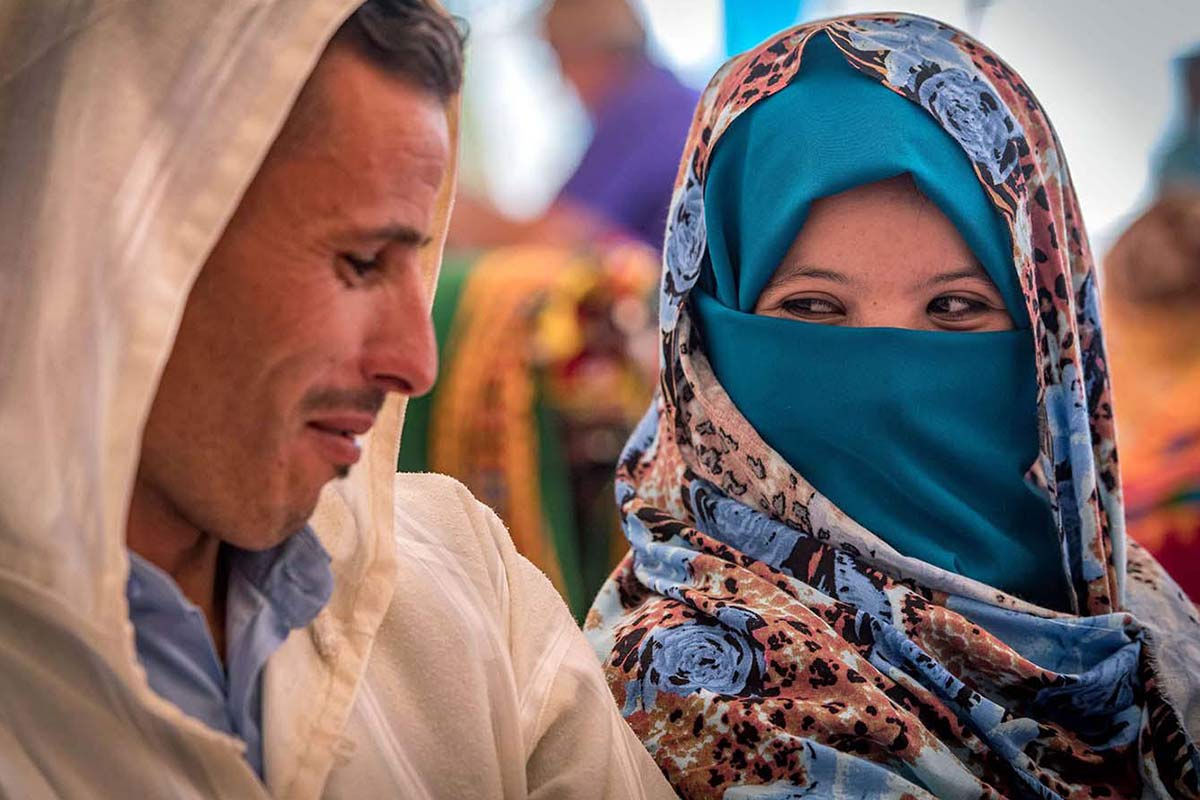
Don’t be fooled into thinking Morocco has fully traded arranged marriage for Western-style dating, though, family is still very much in the room, even when it isn’t literally in the room. Couples who meet on their own, at work, at university, or through a dating app, will almost always end up doing things “the traditional way” eventually: formal family introductions, an official engagement (khitba), and a parental blessing before the wedding is locked in.
In plenty of households, dating exists in a very Moroccan gray zone: everyone sort of knows, nobody really talks about it, and it becomes fully “official” the moment families get involved. Skip that step, and even the most modern Moroccan couple will likely hit resistance; approval from the family isn’t optional, no matter how the relationship started.
Arranged Marriage and Modern Dating: A Blend of Old and New
If you had to sum up love in Morocco today in one sentence, it’d be this: it’s complicated, in the best possible way. A couple might match on an app, text secretly for months, meet up quietly over coffee, and then, once things get serious, suddenly fast-forward into a very traditional engagement, complete with family visits, formal blessings, and a wedding built on centuries-old ritual, henna night and all. Arranged marriage and modern dating aren’t opposites fighting for dominance here; they’re teammates, each handling a different part of the journey.
Why This Story Matters
Morocco’s evolving dance between arranged marriage and modern dating says a lot about the country as a whole: deeply rooted in family and tradition, but increasingly shaped by a generation that wants more say in its own love life. For visitors, it’s a reminder that “conservative” and “changing fast” aren’t mutually exclusive, Morocco is proof you can hold onto your grandmother’s values while also, very quietly, checking your dating app notifications.
One thing hasn’t changed in Morocco: however love starts, it always ends in a party. Discover the traditions behind a real Moroccan wedding.