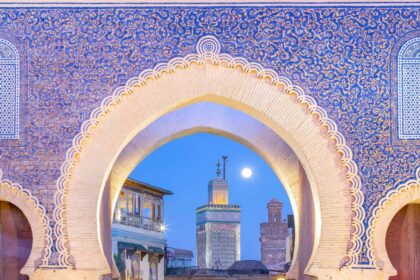




Moroccan Zellige stands among the most celebrated art forms to emerge from Islamic artistic heritage, and it remains a defining feature of the country’s architectural identity. Known worldwide for its intricate geometric patterns and timeless visual appeal, Moroccan Zellige is far more than surface decoration; it’s a living craft tradition built on centuries of history, mathematical precision, and skilled artisanship.
- What Is Zellige?
- The Origins of Moroccan Zellige: A Journey from Al-Andalus to Morocco
- How Zellige Is Made: The Craft Behind the Art
- The Geometry and Symbolism of Zellige Patterns
- Colors of Zellige Through the Ages
- Where to See the Finest Zellige in Morocco
- Zellige in Contemporary Design
- Why Zellige Still Matters Today
- Frequently Asked Questions
What sets Moroccan Zellige apart is the sheer dedication behind it: each tile is hand-cut and individually placed by master craftsmen, resulting in patterns that are as mathematically rigorous as they are visually stunning. From the walls of ancient palaces to modern interior design, Moroccan Zellige continues to represent a powerful link between Morocco’s past and its ongoing artistic legacy.
In this article, we’ll explore what Moroccan zellige actually is, where it came from, how it’s made, and why, nearly a thousand years after it first appeared, it remains one of the most sought-after design elements in the world.
What Is Zellige?
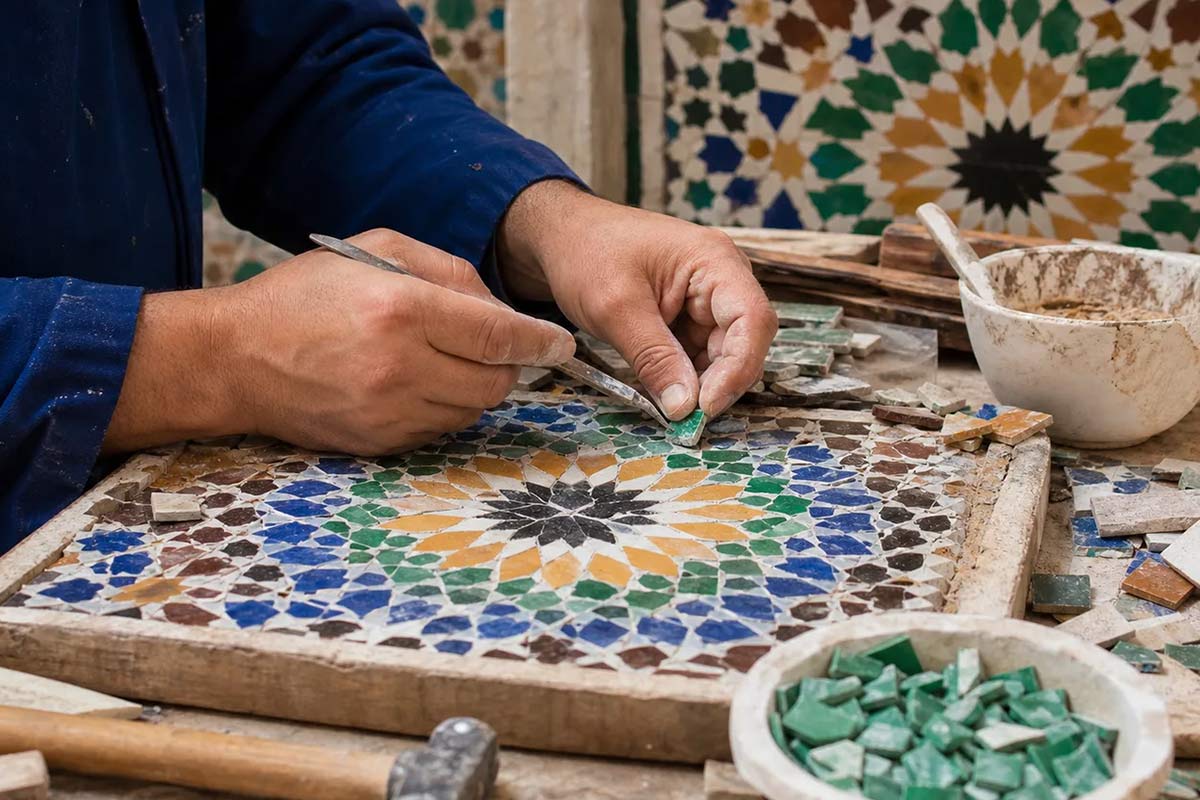
Zellige (pronounced zeh-LEEJ, also spelled zellij or zillij) is a form of mosaic tilework made from individually hand-chiseled geometric tiles set into a plaster or cement base. The word comes from the Arabic “zalij,” which is thought to mean “polished stone” or “tile.”
Unlike printed or machine-cut tiles, every single piece of zellige is cut by hand from a larger glazed tile, then arranged, tile by tile, into complex geometric compositions. It’s used to decorate walls, floors, ceilings, fountains, tables, and courtyards, and it remains one of the defining visual signatures of Moroccan architecture.
The Origins of Moroccan Zellige: A Journey from Al-Andalus to Morocco
The Hispano-Moorish roots
The story of Moroccan zellige begins earlier than most people expect. This ancient form of Moroccan decorative art traces its roots to the 10th century in the city of Fes, developing alongside the broader Hispano-Moresque artistic tradition that flourished across the Maghreb and Al-Andalus, the Muslim-ruled regions of what is now Spain and Portugal, between the 8th and 15th centuries.
This shared heritage explains why you’ll notice striking similarities between Moroccan zellige and the azulejo tilework still found in southern Spain and Portugal today. Both crafts grew from the same artistic root, even as they evolved along separate paths after 1492.
The Marinid Dynasty and the Rise of Fes
Moroccan Zellige truly came into its own under the Marinid dynasty, which ruled Morocco from the 13th to the 15th century. Craftsmen refined the technique significantly during this period and introduced blue, green, and yellow glazes to what had previously been a more limited palette, while red was only added to the zellige color palette in the 17th century.
During Marinid rule, Fes became the undisputed center of zellige production, and the tiles were used to adorn palaces and major buildings throughout the city, helping to earn Fes the nickname “Athens of Africa.” That reputation has never really faded. Fes and Meknes remain the historic centers of zellige craftsmanship in Morocco to this day.
How Zellige Is Made: The Craft Behind the Art
The Clay of Fes
Part of what makes authentic Moroccan zellige so distinctive is literally in the ground it comes from. Fes and Meknes owe their status as production centers to the region’s specific Miocene grey clay, which gives the tiles their particular texture and firing qualities. This is why, even centuries later, most of Morocco’s zellige workshops are still concentrated around Fez.
Hand-Chiseling and the Maalem Tradition
Making a single zellige tile is a slow, multi-stage process, largely unchanged for centuries:
- Shaping: Clay is pressed into square molds and left to dry into flat slabs.
- Firing and glazing: The slabs are fired in a kiln, then coated in a single color of glaze and fired again.
- Hand-chiseling: A master craftsman, called a maalem, uses a small hammer and chisel to cut each glazed tile into the precise geometric shape needed for the pattern: a star, a cross, a hexagon, a teardrop.
- Assembly: The individually cut pieces are laid face-down in a mold and set into plaster or cement, creating a panel that is then flipped and installed as a single mosaic surface.
Becoming a maalem takes years of apprenticeship, and the skill is traditionally passed down within families and workshops in Fes, making every piece of authentic zellige not just decoration, but a living link to a centuries-old guild tradition.
The Geometry and Symbolism of Zellige Patterns
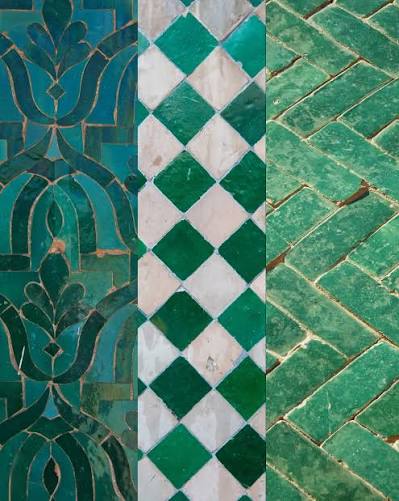
One of the most fascinating things about zellige is why it looks the way it does. Because Islamic artistic tradition avoids depictions of living beings in religious and decorative contexts, artisans turned instead to geometry as their primary language of expression.
The result is an entire visual system built from stars, polygons, interlacing lines, and repeating motifs and patterns that can be endlessly varied but are always mathematically precise. Many of these designs are based on the eight-pointed star (khatim), a motif with deep symbolic resonance across Islamic art, representing balance, infinity, and the underlying order of the universe. Far from being purely decorative, zellige patterns were historically understood as expressions of spiritual and mathematical harmony.
Colors of Zellige Through the Ages
Zellige’s color palette has expanded gradually over the centuries:
- Early zellige was largely limited to white and brown tones.
- Blue, green, and yellow were introduced during the Marinid period, in the 14th century.
- Red entered the palette later, in the 17th century.
- Modern zellige now comes in an enormous range of colors, including the deep cobalt blue associated with Chefchaouen and the emerald green tiles seen on mosque roofs and minarets across Morocco.
Each color historically carried its own significance and cost; cobalt blue, in particular, was prized and expensive to produce, which is partly why it became associated with wealth and status in palace decoration.
Where to See the Finest Zellige in Morocco
If you’re planning a trip and want to see zellige at its best, a few sites stand out:
Bou Inania Madrasa (Fes / Meknes)
Completed in 1358 under Sultan Abu Inan Faris, this Quranic school is considered one of the finest examples of Marinid architecture, with elaborate zellige work covering its lower walls alongside carved cedar and stucco.
Bahia Palace (Marrakech)
A 19th-century palace renowned for its lavish use of zellige across courtyards, reception halls, and private apartments, a favorite stop for anyone touring Marrakech’s historic medina.
Hassan II Mosque (Casablanca)
One of the largest mosques in the world, and a showcase for contemporary zellige craftsmanship on a monumental scale, proving the art form is still very much alive today.
Zellige in Contemporary Design
In recent years, zellige has had a major moment far beyond Morocco’s borders. Interior designers around the world now use handmade zellige tiles, often imported directly from Fez workshops, in kitchens, bathrooms, and feature walls, drawn to the tiles’ irregular, hand-crafted texture and the subtle color variation that no machine-made tile can replicate.
This global demand has also helped sustain the traditional craft at home, giving Moroccan artisans a growing international market for a skill passed down over generations.
Why Zellige Still Matters Today
Zellige endures because it sits at a rare intersection: it’s mathematically rigorous yet handmade, ancient yet constantly reinterpreted, deeply local yet globally admired. For travelers, encountering it in person running a hand across a fountain in a Fes riad, or standing beneath a zellige-covered dome is one of the most tangible ways to connect with Morocco’s artistic history.
Frequently Asked Questions
- What does “zellige” mean?
Zellige comes from the Arabic word zalij, generally translated as “polished stone” or “tile.” - Where does zellige come from?
Zellige originated in Morocco, with roots tracing back to the 10th century in Fez and to the broader Hispano-Moorish artistic tradition of Al-Andalus. - Is zellige handmade?
Yes. Every piece of authentic zellige is hand-cut and hand-chiseled by a master craftsman known as a maalem, then hand-assembled into mosaic panels. - What’s the difference between zellige and regular tile?
Zellige tiles are individually shaped by hand and set into geometric mosaic patterns, giving each piece slight natural variation, whereas standard tiles are machine-cut and uniform.