



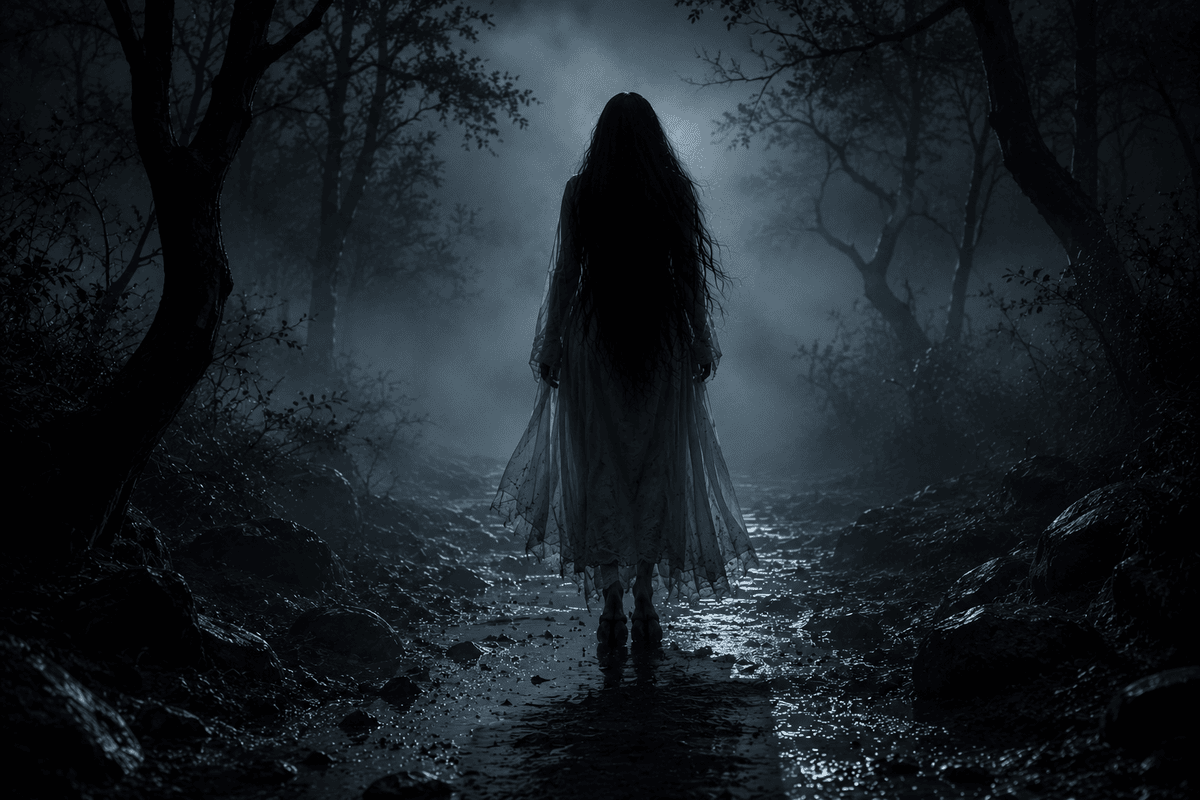
It is believed she appears at night, near rivers, lonely roads, and deserted stretches of coastline. Beautiful, with long, flowing black hair and an enchanting siren-like voice, she draws unsuspecting men towards her. But beneath her clothing hides a horrifying secret: the hooves of a goat.
Her name is Aïcha Qandicha, one of the most infamous Moroccan folklore figures.
According to popular belief, those who fall under her spell may lose their minds, disappear, or become victims of her supernatural power. For generations, her name has been whispered as a warning, turning her into a creature of seduction, madness, and terror.
But another version of her story tells a very different tale.
The Woman Behind The Monster
According to the popular Moroccan legend, Aïcha was once a beautiful young woman from the region of El Jadida, during the sixteenth-century Portuguese presence along the Moroccan coast.
The story says she actually fought against the Portuguese by using her beauty to lure enemy soldiers into traps, where Moroccan fighters waited to kill them. When the Portuguese retaliated by killing her beloved and, in some versions, her family, Aïcha was consumed by grief and vengeance.
She disappeared into the wilderness, and the story of a brave woman resisting an invading force gradually became a tale of a supernatural being who preyed on men.
It is a haunting transformation, though: the woman who once hunted her enemies became the monster parents invoked to frighten their children.
Was Aïcha Qandicha a real resistance fighter?
Historians have not established reliable evidence confirming that this woman existed as described. The story of the beautiful resistance fighter remains an origin legend, passed down and reshaped through oral tradition. If a historical identity behind Aïcha Qandicha existed, it remains uncertain.
When a Woman’s Power Becomes Something to Fear
Whether or not the resistance story has a historical basis, Aïcha’s legend offers a fascinating lens for examining Moroccan female power.
In one version, she is a woman who uses intelligence, beauty, and courage to fight an invading force of the colonizers at that time. In another, she is a dangerous seductress Jinn whose sexuality drives men to madness out of pure joy and revenge. One thing that does not change: her power remains, but its meaning does.
Through a feminist reading, we might ask why a woman who chooses her own targets, exercises sexual agency, and inspires fear becomes such a compelling figure of monstrosity. Male heroes are often remembered for their conquests, while a woman who conquers through seduction can become a source of unease.
This makes you think about how sexuality is demonized when it comes to women and celebrated when it comes to men. If her story were real, this woman sacrificed her body for the sake of her land to seek revenge on the colonizers, which takes real strength and courage to look your opponent in the eye and keep a straight face.
This does not prove that her legend was deliberately rewritten to punish female independence, though, but it reveals a tension worth exploring: the same qualities that make a woman formidable can also make her frightening to the society that remembers her.
Perhaps Aïcha’s enduring fascination lies in that contradiction. She is both desired and feared, both victim and predator, both woman and monster, which to me just reflects our struggles as women in general.
She was just a woman.
Reclaiming Her Legacy
Today, Aïcha Qandicha remains one of Morocco’s most recognisable folkloric figures, appearing in cultural scholarship, music, film, and contemporary artistic interpretations. Her story continues to invite new readings of female sexuality, anger, and resistance.
We may never know whether she was a real woman who inspired the legend, but perhaps the question worth asking is not simply whether Aïcha was a heroine or a monster.
It is why does her story allow her to be remembered as a monster at all?
Behind the hooves, the haunting, leery voice, and the whispered warnings stands a figure who refuses to be forgotten. And whether she began as a woman, a spirit, or a story shaped by generations of imagination, Aïcha Qandicha reminds us that folklore is never just about the monsters we fear.
Sometimes, it is also about the power we do not know what to do with.